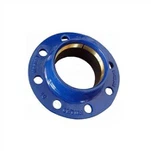
PVC saddle clamps are key fittings for pipe branch connections, and their pressure resistance directly impacts system safety. Statistics show that approximately 30% of pipe leakage accidents are caused by insufficient pressure resistance of fittings. Therefore, researching the structural factors influencing this performance holds significant engineering value.
I. Basic Structure and Working Principle
1.1 Basic Structural Components
A PVC saddle clamp mainly consists of the following key parts:
Saddle Base: The part in contact with the main pipe, usually designed with a semicircular or saddle-shaped curved surface to fit the outer surface of the main pipe.
Branch Port: The outlet for connecting branch pipes, typically featuring a threaded or socket structure.
Clamping Mechanism: A device used to fix the saddle clamp to the main pipe, commonly available in two types: bolt-clamped and bolt-free wedge-fixed.
Sealing Assembly: Usually composed of an EPDM rubber sealing ring, located at the contact area between the saddle clamp and the main pipe to ensure sealing performance.
Reinforcement Structure: Some high-pressure saddle clamps are designed with reinforcing ribs or metal reinforcement structures at the branch port to enhance overall strength and durability.
1.2 Working Principle and Connection Methods
The working principle of a PVC saddle clamp is based on mechanical clamping and sealing cooperation. Its basic working process is as follows:
Installation Process: First, drill a hole in the main pipe, then fit the saddle base of the clamp onto the pipe surface, and secure the saddle clamp to the pipe using the clamping mechanism.
Sealing Mechanism: Under the action of clamping force, the sealing ring inside the saddle clamp is compressed to fill the gap between the saddle clamp and the main pipe, forming a sealing barrier.
Branch Connection: The branch pipe is connected through the branch port of the saddle clamp to form a complete pipe system.
Based on the clamping method, PVC saddle clamps are mainly divided into two types:
Bolt-Clamped Type: Uses bolts and nuts to fix the saddle clamp to the main pipe, with clamping force adjusted by controlling the bolt torque.
II. Key Structural Influencing Factors
2.1 Body Material and Wall Thickness
Materials:
PVC-U (Unplasticized Polyvinyl Chloride): Has high hardness and rigidity, strong chemical corrosion resistance, but relatively low toughness (compressive strength: 40-55 MPa).
Impact-Modified PVC: Improves toughness and impact resistance by adding impact modifiers, suitable for high-pressure environments.
PVCO (Biaxially Oriented Polyvinyl Chloride): Significantly enhances material strength and toughness through a special processing technology that orients molecular chains axially and circumferentially, with better pressure resistance than ordinary PVC.
Wall Thickness:
When the wall thickness of the saddle base increases from 3mm to 5mm, the pressure resistance of the saddle clamp can be improved by about 40%.
The wall thickness of the branch port needs to be 20-30% thicker than that of the saddle base to enhance its anti-cracking ability.
According to ASTM standards, for saddle clamps with a nominal diameter (DN) less than 110mm, the minimum wall thickness should not be less than 3.2mm; for those with a DN between 110mm and 315mm, the minimum wall thickness should not be less than 4.5mm.
2.2 Clamping Mechanism
Clamping Force:
It needs to compress the sealing ring by 20-30% to achieve effective sealing. Exceeding 80% of the material's yield strength will easily cause deformation.
A four-point bolt clamping design can improve pressure resistance by approximately 15% compared to a two-point design, as it provides more uniform clamping force distribution.
Types:
Bolt-Clamped Type: Allows adjustable clamping force and is suitable for pipes of various diameters, but has uneven force distribution (prone to stress concentration).
Wedge-Fixed Type: Features easy installation and relatively uniform force distribution, with an optimal wedge angle of 15-20°, but its clamping force is difficult to control and requires high manufacturing precision.
Clamp-Clamped Type: Offers uniform force distribution and is suitable for large-diameter pipes, but has a complex structure and 25% higher cost (pressure resistance is about 10% higher than the bolt-clamped type).
2.3 Sealing Structure
Sealing Ring:
EPDM (Ethylene Propylene Diene Monomer) Rubber: Has excellent weather resistance, ozone resistance, and chemical corrosion resistance, suitable for most water and wastewater applications (pressure resistance: up to 1.6 MPa at room temperature).
Silicone Rubber: Exhibits excellent high-temperature resistance (maintains elasticity between -50℃ and 200℃) but is less resistant to chemical corrosion than EPDM.
Recommendation: EPDM sealing rings with a hardness of 60-70 Shore A (balances sealing performance and minimizes damage to the PVC surface).
Seal Groove:
Depth: 70-80% of the sealing ring diameter (to ensure a 20-30% compression rate).
Width: 10-15% larger than the sealing ring diameter (to avoid over-squeezing of the ring).
Position: Located on the high-pressure side of the contact surface between the saddle clamp and the main pipe (to leverage medium pressure for auxiliary sealing).
III. Conclusion and Outlook
Through continuous research and innovation, the pressure resistance and overall performance of PVC saddle clamps will be continuously improved, providing stronger guarantees for the safe and reliable operation of various pipe systems.