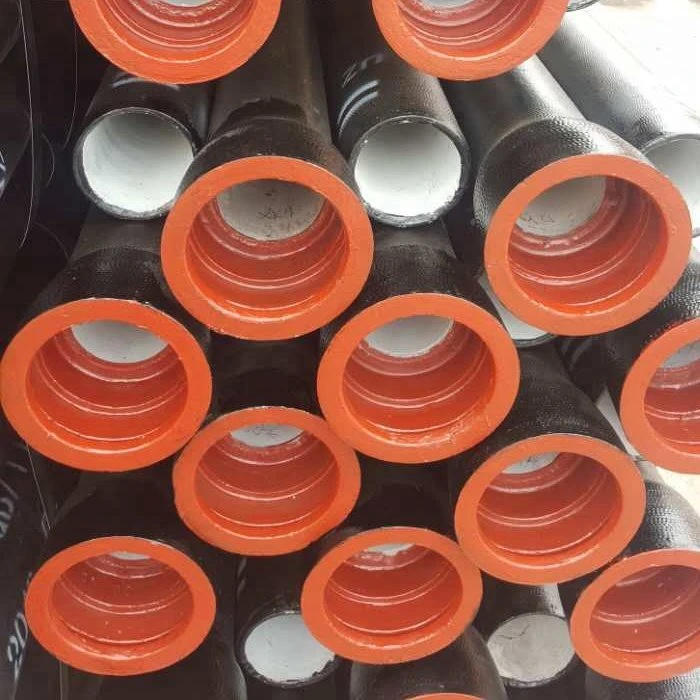
Every ductile iron pipe begins as a stream of molten metal. What transforms that liquid into a pressure-rated, corrosion-resistant pipeline component is a manufacturing process refined over decades: centrifugal casting. At TianyiSuns, we operate this process at the core of our pipe production, and understanding how it works helps explain why the finished pipe performs the way it does.
The Principle Behind Centrifugal Casting
Centrifugal casting uses rotational force to distribute molten iron against the inner wall of a rotating metal mold, known as a "mold" or "die." Once the iron is poured, the mold spins at high speed. Centrifugal force presses the molten metal outward against the mold surface, where it solidifies uniformly.
This method produces a dense, uniform pipe body with a smooth internal surface-advantages that other casting methods cannot easily replicate. The spinning action also drives impurities and gases outward, reducing internal defects and improving the structural integrity of the finished pipe.
The Production Sequence: From Melt to Finished Pipe
1. Raw Material Preparation
Production begins with carefully selected raw materials, including pig iron, steel scrap, and alloying elements. All incoming materials undergo chemical analysis to verify composition and confirm suitability for ductile iron production.
2. Melting and Desulfurization
The raw materials are melted in an induction furnace. Because sulfur severely impairs the ductility of iron, the molten metal undergoes desulfurization before casting, reducing sulfur content to a level suitable for spheroidization.
3. Spheroidization and Inoculation
This crucial step is what gives ductile iron its name. Magnesium is added to the molten metal, which causes the graphite to form as nodules instead of flakes. Then, inoculation occurs, refining the graphite structure and ensuring consistent mechanical properties throughout the casting.
4. Centrifugal Casting
The prepared molten iron is poured into a rotating mold. Centrifugal force distributes the metal evenly along the mold length, producing a pipe with uniform wall thickness and a dense structure. The pipe is then cooled under controlled conditions to prevent cracking and ensure the desired metallurgical structure.
5. Annealing and Heat Treatment
After casting, the pipe undergoes annealing to relieve internal stresses, soften the structure to the required ductility, and achieve the specified mechanical properties. Temperature profiles are carefully controlled throughout the heat treatment cycle.
6. Machining of the Socket and Spigot
The socket end and spigot end are precisely machined to ensure dimensional accuracy and compatibility with standard joints and gaskets. This step is essential for achieving leak-free, restrained connections in the field.
7. Coating and Lining
The external surface receives a metallic zinc coating plus a finishing layer, while the internal surface is lined with cement mortar or another protective material. These treatments provide the corrosion resistance that allows ductile iron pipes to perform for decades in buried service.
8. Hydrostatic Testing and Inspection
Every finished pipe undergoes hydrostatic pressure testing to verify that it can withstand rated working pressures without leakage. Dimensional checks, visual inspection, and material verification follow before the pipe is approved for shipment.
What the Process Delivers
The centrifugal casting process is not simply a production method-it determines the properties that matter in service. The dense structure produced by the spinning action resists internal pressure and external loads more effectively than static casting. The uniform wall thickness ensures predictable performance under pressure. The controlled cooling and annealing sequence delivers the ductility required for handling, installation, and resistance to ground movement. The internal lining provides the corrosion resistance and hydraulic efficiency needed for decades of water transmission.
Quality Control at Every Stage
TianyiSuns utilizes a process-focused quality system. Incoming raw materials undergo testing before acceptance. The chemistry of molten metal is monitored during melting and spheroidization. Parameters for casting-such as mold speed, pouring temperature, and cooling rate-are controlled to ensure consistent output. Finished pipes undergo hydrostatic testing, dimensional verification, and visual inspection before release.
Applications
The pipes produced through this process serve municipal water transmission and distribution networks, wastewater collection systems, irrigation infrastructure, and industrial process water lines. In each application, the centrifugal casting process provides the combination of strength, ductility, and corrosion resistance required for long-term, reliable service.
Conclusion
Centrifugal casting transforms molten iron into a pipe capable of serving underground for decades. The process combines precise control of raw materials, metal chemistry, rotation speed, and thermal treatment-each step contributing to the final properties of the product. At TianyiSuns, this process forms the foundation of our ductile iron pipe production, and understanding it helps customers appreciate what they receive when they specify our pipe.