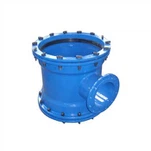
Many engineers working on municipal water supply and sewage projects tend to treat flange spigots as simple transition fittings and overlook their importance. At pipeline nodes, however, it acts as the only transition hub between push-on flexible joints and rigid flanged equipment. Dimensional precision, sealing compatibility, and coating system directly affect maintenance accessibility and leakage risk for valves, water meters and dismantling joints.
Balancing Boundary: Rigid Flange End vs Flexible Spigot End
The unique feature of a flange spigot lies in its two ends with different connection properties. The flange end forms a rigid bolted joint without angular deflection, while the spigot end is a push-on flexible socket joint sealed by a compressed rubber gasket. It allows controlled angular deflection to absorb minor ground settlement and installation misalignment.
Common defects from low-cost castings include poorly machined flange bolt circle and gasket face, out-of-round spigot OD and irregular guiding taper. In field assembly, this causes gasket offset leakage or incomplete insertion, leading to the rubber ring rolling out.
TinayiSuns enforces strict in-house machining controls. Flange sealing faces are fully machined with tight positional tolerance on bolt holes. The outer profile and guiding taper of the spigot are formed in one pass, matching the EN545 / ISO2531 socket cavity to guarantee even compression of EPDM gaskets. Permitted deflection angles are defined by DN size; larger diameters allow smaller deflection. We mark these limits on shop drawings to prevent over-flexing beyond design safety limits.
Gasket Matching Is Not a Universal Fit
Most push-on joint seal failures stem from mismatched spigot profile and gasket section rather than poor rubber material. Natural rubber degrades and swells quickly in sewage containing hydrogen sulfide. Potable water service requires rubber compounds approved for contact with drinking media.
TinayiSuns supplies application-specific gaskets: drinking water grade EPDM for clean water lines, special H2S-resistant EPDM for sewage and corrosive media. We validate each gasket together with the corresponding spigot profile. Tyton self-sealing gaskets and T-type gaskets are not interchangeable. Wrong selection creates hidden leakage that only appears during hydrostatic testing, with extremely high locating cost once buried.
TinayiSuns supplies application-specific gaskets: drinking water grade EPDM for clean water lines, special H2S-resistant EPDM for sewage and corrosive media. We validate each gasket together with the corresponding spigot profile. Tyton self-sealing gaskets and T-type gaskets are not interchangeable. Wrong selection creates hidden leakage that only appears during hydrostatic testing, with extremely high locating cost once buried.
Zoned Coating Instead of One Single Coating for All Surfaces
Coating requirements differ for flange faces, bolt holes and spigot working surfaces. A full heavy FBE coating over the flange sealing face prevents proper gasket compression. Over-thick coating on the spigot taper changes clearance, increases push-in force and scratches the sealing ring.
TinayiSuns applies zoned coating control:
Potable water: Cement mortar lining internally + FBE epoxy externally, with reduced coating thickness on flange sealing faces for gasket seating
Sewage / aggressive soil: Full FBE epoxy on inner and outer surfaces, chamfered bolt holes for anti-corrosion
Temporary pipelines & irrigation: Bitumen coating for faster delivery
We can provide third-party test reports for coating adhesion and cathodic disbondment, accepted by supervisory inspectors for export projects.
Pressure Rating: Flange Rating and Spigot Structure Must Be Synchronized
PN10, PN16, PN25, PN40 mark the flange class, but many suppliers only label the flange rating while producing the spigot body to low-pressure wall thickness and socket design. This creates a hidden risk: the flange holds pressure while the push-on joint fails first.
TinayiSuns designs wall thickness, metallurgy and nodularity to match the marked pressure rating on both ends. Ductile iron grades 450-12 / 500-7 with stable nodularity, each batch supplied with metallurgy and MTC certificates. Every single fitting undergoes an individual hydrostatic test at elevated pressure, not random batch sampling.
Standard & Custom Length for Valve Chamber Installation Clearance
Standard-length flange spigots suit regular pipe runs, while pump stations, valve chambers and wall penetrations often require custom overall length. Changing the effective length between flange and spigot may reduce settlement allowance and wrench access space for flange bolts.
TinayiSuns offers custom overall length, flange thickness and spigot guide length based on valve chamber drawings, with minimum bolt clearance stated clearly. Many on-site problems where technicians cannot reach flange bolts originate from unchecked effective length at the design stage.
Application Boundary: Where to Use and Where to Avoid
Recommended: Transition between ductile iron push-on pipelines and flanged equipment including valves, pumps, water meters, dismantling joints and air release valves; nodes inside valve chambers requiring periodic disassembly without cutting existing socket pipes; rehabilitation jobs connecting two joint types.
Not suitable: Locations requiring large continuous angular movement or repeated axial elongation, where dismantling joints are preferred; high-pressure lines requiring fully rigid restraint.
As an interface adapter, the flange spigot does not merely connect two pipes. It transfers settlement tolerance from flexible pipelines to non-deflectable flanged equipment and prevents stress concentration that cracks valves or gaskets.
The reliability of a pipeline system often hinges on these easily overlooked transition fittings. Centered on real project operating conditions, TinayiSuns balances precision machining, stable sealing and long-term anti-corrosion performance. We help customers eliminate on-site troubles, including hidden joint leakage, assembly interference and acceptance delays at the source, delivering durable interface solutions for water and wastewater projects.