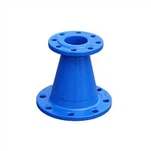
In the streets and alleys of the city, we can see the figure of ductile iron manhole covers everywhere. Although not eye-catching, they play a crucial role in urban infrastructure.
Material characteristics
Ductile iron manhole covers have excellent material properties. Its strength and toughness are top-notch, and it has high strength and can withstand significant pressure. Generally speaking, according to different standards and grades, ductile iron manhole covers can withstand vehicle loads of 10-90 tons or even higher.
Through special spheronization treatment, graphite is distributed in a spherical shape in the iron matrix, which endows the manhole cover with the ability to withstand high pressure and impact forces. Whether heavy trucks are frequently crushed on urban main roads or vehicles generate abnormal impacts during winter road icing, ductile iron manhole covers can maintain their integrity and reduce the possibility of damage.
Moreover, in terms of corrosion resistance, ductile iron manhole covers also perform well. Its surface can be coated with anti-corrosion measures such as a zinc layer or epoxy coating. The zinc layer can preferentially corrode through electrochemical action, protecting the internal iron matrix. Epoxy coating can resist chemical erosion such as acid rain and sewage, which enables manhole covers to be used for a long time in drainage facilities in harsh environments such as chemical parks and beaches.
Manufacturing process and quality control
The manufacturing process of ductile iron manhole covers is a delicate process that includes multiple steps such as melting, spheroidizing, casting, forming, and processing. Strictly regulate the melting temperature and chemical makeup of raw materials, such as scrap steel and pig iron, throughout the smelting process. After that, apply the appropriate amount of spheroidizing agent to initiate the spheroidization process. To ensure consistent mold filling and to prevent defects such as pores and sand holes, it is essential to carefully monitor the temperature of the molten iron and the casting speed during the casting process. Cutting, trimming, mechanical processing to guarantee dimensional accuracy, and surface treatment, including polishing and rust removal, are still necessary for the produced manhole cover. To prevent corrosion, apply the corresponding coating.
In terms of quality control, testing the dimensional accuracy, surface quality, and load-bearing capacity of manhole covers is an important step. Relevant industry or national standards, such as stringent guidelines on characteristics like manhole cover thickness and diameter, must be met for dimensional accuracy. The manhole cover surface must be level and free of visible casting flaws such as pores and sand holes to meet the surface quality standard. The bearing capacity test tests the manhole cover's ability to reach the designated bearing level by simulating the real vehicle load scenario and applying pressure.
Application scenarios
Ductile iron manhole covers are the recommended option for high-traffic areas, such as city main highways, under overpasses, and on roadways at ports and docks. Ductile iron manhole covers are crucial in locations with heavy traffic and a high volume of large vehicles, as they help maintain road safety and functionality. In industrial settings, such as steel and chemical plants, these manhole covers can endure the weight of heavy vehicles and the demanding conditions of industrial operations, effectively safeguarding access points to pipelines. For infrastructure that requires long-term reliability, such as manhole covers in sewage treatment plants and water facilities, the corrosion resistance and high strength of ductile iron manhole covers guarantee their effectiveness in harsh conditions, including high humidity and exposure to chemicals.
In short, ductile iron manhole covers ensure the normal operation of cities, providing indispensable safety and functional support for our lives and production, whether in bustling urban streets or busy industrial plants.